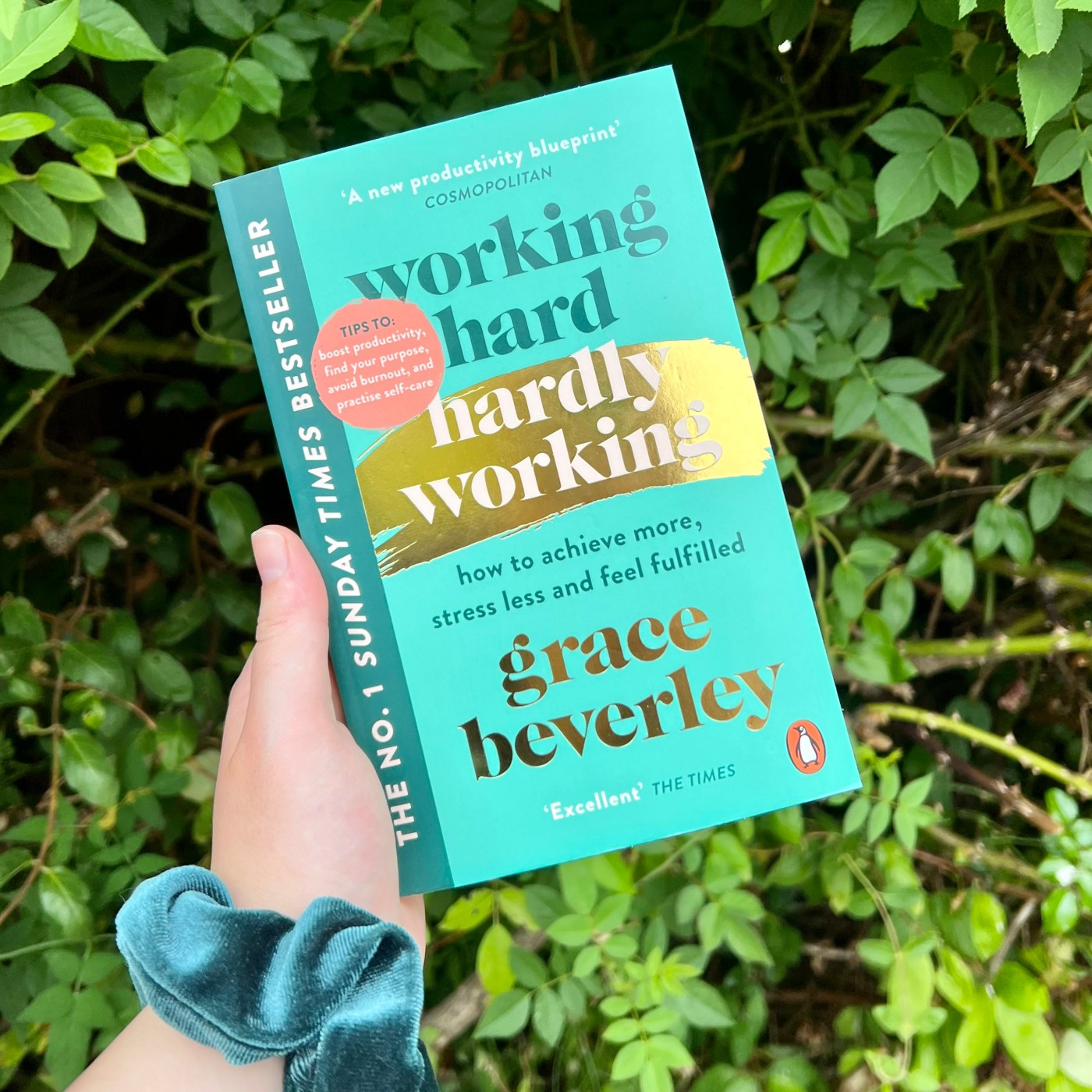
*spoilers ahead*
Grace Beverley’s Working Hard, Hardly Working is a self-help book aiming to bring a fresh perspective to the working world on how to balance working effectively for both your career and your well-being. Beverley is a social media influencer turned entrepreneur who grew her fitness brands TALA and Shreddy.
I have been a follower of Beverley for quite a few years now and found her as an inspiration for young people. I was excited when I heard she was publishing her book but delayed reading this as more and more mixed opinions occurred over time. Unfortunately, for me, Working Hard, Hardly Working was quite underwhelming in terms of offering practical tips. However, there are great discussions around the toxicity of side hustle culture, delving into the idea that in today’s society a hobby should always have a profit associated with it, or how any spare time a person has should be dedicated to bettering themselves by learning a new trade. Although there is a high opportunity cost when we are not pursuing other things in our spare time, this view can be damaging especially as younger generations are already burned out.
I found the discussions around the realities of corporate culture important, especially as this resonated more with me as I am now in a full-time corporate role. Beverley talks explicitly about how to avoid the trap of staying late at work to make a good impression. From a personal perspective, even working from home I still see the ‘don’t be the first person to log off’ vibe, similar to a ‘don’t be the first person to leave the office’ situation. This can be difficult to navigate when many people already work an insane number of hours. There is often an odd competition at the end of the year as to who has taken the least amount of annual leave as they have been so busy.
This also related to the parallels we see between team productivity vs team self-care, and what that truly means. Essentially Beverley asserts that being productive can be a form of self-care, and self-care (in any way you perceive) can also be the most productive thing we can do. Our needs change depending on the circumstances and so productivity and self-care do not always need to be seen as separate silos.
‘The beauty of self-actualising is that it can show us how to make our work work for us, and how to find happiness in the process, while acknowledging that work isn’t something you’re going to leap out of bed for every single day.’
p31
Whilst I found these discussions enjoyable, the practical tips provided were very basic. For example, large sections of the book focused on how to manage your time and prioritise. I was already familiar with the suggestions Beverley was making, and whilst this was reassuring to read as they were advocated by another individual, there wasn’t anything new for me. Most of the theories/models discussed such as setting SMART targets, producing a SWOT analysis and even basic things such as installing Grammarly, were things I had covered at school. I was excited to learn something new and refreshing but this did not happen.
Fundamentally, Beverley tended to miss the mark with the purpose of her book. For example, a frequent productivity tip was to ‘just start’ on your work or to ‘cut the crap and focus on discipline’ which I found quite unsympathetic. Whilst I understand that procrastination makes things worse, these situations usually happen when there are underlying issues, whether that’s at work or in your personal life. Sometimes Beverley appears unaware of this which is a little frustrating.
Another issue I had with this book, was some of the ignorance I felt from Beverley as an author. This in particular was disappointing as I genuinely like Beverley as an influencer, but fear she lacks self-awareness. Whilst she does acknowledge her privilege every so often in terms of being privately educated, her race, class status and home environment, her advice was not inclusive to those who do not fit her demographic.
‘I’ve come to terms with the fact that no one with a background like mine can truly be ‘self-made’ when society is rigged.’ –
p115
What I found difficult was although Beverley said the above, the productivity tips she continued to write about would only be appropriate for certain people. The book should have really been marketed to those who are self-employed or entrepreneurs as these are people who can allow flexibility within their role. In the book, there is a lot of advice to ‘find out what works for you’ and ‘these tips won’t work for everyone’ that felt like a bit of a cop-out to me. Upon reflection, I felt like this book could have been a section of an autobiography or memoir instead to show how Beverley has come to be the woman she is instead of trying to impose this on others. This would have allowed Beverley to talk more about the behind-the-scenes with her sustainable fashion brand TALA which she touched on every so often. Also, when this book was first published it cost £16.99. This for me also proved how the book was marketed wrongly, as this is not an accessible book due to the price, especially if you are a student or someone who simply cannot afford the price of a book that’s less than 250 pages.
Overall, my highlights with this book were definitely the theory/discussion side as it’s always refreshing to talk about the toxicity of the corporate world. This is not a revolutionary self-book by any means but is a short book to get through. Saying that I do feel like this book could have been shortened even more. I do always find non-fiction harder to read as it’s heavier to digest but this did cause the pacing to be off. Unfortunately, this was quite a disappointing read for me.
2/5 stars
 Soph's Library
Leave a comment