
*spoilers ahead*
The Secret History is by far one of the best fiction books I have read in a long time. As a warning, this review will be one of my longer ones as there is just so much to discuss! The story is narrated by Richard, a college student who joins Hampden College in Vermont, where Tartt was actually a student between 1982 and 1986. Richard soon joins an elite, Greek academic group which becomes his major, soon taking over his entire life also. Richard is infatuated by his new, mysterious Professor, Julian Morrow, and the others in his class – Bunny, Henry, Francis and twins Charles and Camilla.
When beginning The Secret History, I was quickly sceptical of the introduction of so many characters, who all seemed of high importance. I feared accidentally missing crucial information about them, but Tartt should be credited with her ability to give great attention to each character she discussed. Tartt also writes in an extremely detailed way, with interesting descriptions of both people and scenery.
The Secret History is separated into Book I and Book II, followed by an epilogue. Book I takes the reader on an intriguing and captivating journey on the adventures of Richard and his new friends. We learn more and more about each character and the complicated variables that combine them all together. Whilst the book is set in America, Tartt is extremely clever in depicting a new and unique world that is different from the reality we see it in today. I particularly liked how in Book I Tartt concentrates on Julian, allowing me to believe he would be the most discussed character. I was pleasantly surprised that the book continued to focus on many characters, not just this one. It is in Book I that we get the first mention of Bunny’s murder, a shocking but captivating crime that impacts the characters in more ways than one could imagine. Richard does not tell his story in direct chronological order, but interjects with his own thoughts and flashbacks, infiltrating the current narrative.
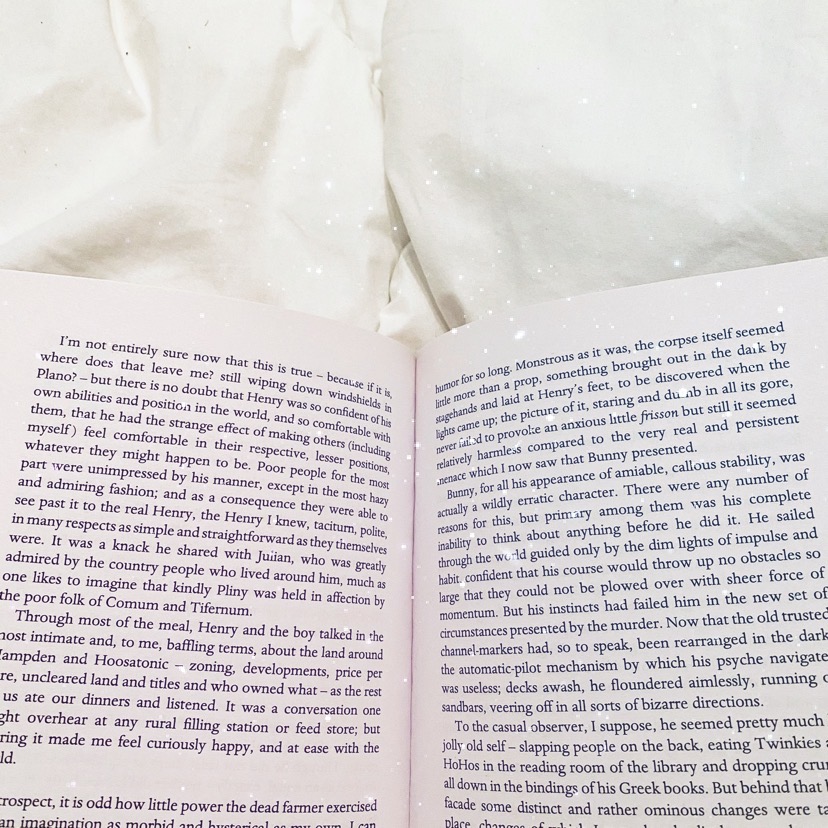
Initially, I found the idea of the friends murdering Bunny as a bit far-fetched, but Tartt effectively executes the madness in which the characters live in. The fact they study Greek is not by coincidence, as Bunny, Henry, Francis, Charles and Camilla become infatuated with exploring the ability of a higher power through a bacchanal. This led to the accidental murder of a local farmer, the watershed of the disaster which consumes the group. We learn that Henry is typically the leader of the group’s unusual activity and is even the one to plan how to murder Bunny, after his growing concerns that Bunny was going to reveal that the others were responsible for the farmer’s murder.
Once again, I was concerned that the sole justification behind Bunny’s death was the possibility that Bunny could tell somebody about the murder, and that was again a bit fanciful, but Richard raises this concern directly to Henry. Bunny appears to have been a problem for a long time, constantly rinsing Henry and his other friends of money and being nothing but a bother, often blackmailing them with his knowledge of the murder. Events quickly escalate when Bunny becomes paranoid that Henry is trying to kill him, which leads to Richard becoming involved and being told the truth after the farmer’s murder.
Religious slurs, temper tantrums, insults, coercion, debt: all petty things, irritants – too minor, it would seem, to move five reasonable people to murder.
The Secret History
Book I ends with Bunny’s chilling murder; being pushed off the edge of a cliff when a highly-intoxicated Bunny went for a walk after a party. Now, we enter Book II in which Richard explains the events immediately after Henry pushed Bunny. I particularly liked Tartt’s blunt descriptions of what happened, like those of the quote below.
In short, that given the variables in our case, our particular falling body was travelling at a speed greater than thirty-two feet per second when it hit the rocks below.
The Secret History
Throughout the second half of the book, the reader learns more about each character right until the end of the book. I especially found the relationship between Richard and Henry the most interesting as Henry is perceived to be the most intelligent out of the group, with Henry himself also seeing Richard on the same level. Sub-characters such as Judy and Cloke were also interesting to read about too. It was refreshing to learn about minor characters in enough depth that they complimented the narrative, but not too much that it detracted from the main plot.
However, as we came towards the end of the book the only disappointing aspect I discovered was the lack of closure regarding Julian. Whilst I was previously happy that Julian did not dominate the narrative in Book I, I found Tartt’s decision to write out Julian quite disappointing; it is explained that Julian left the country out of panic and fear after discovering his students were responsible for Bunny’s murder. However, this did work in terms of Henry’s justification to shoot himself at the end of Book II. The ending of The Secret History is one of the most dramatic and suspenseful endings I have ever read and so for that reason, Julian’s departure did not affect my review of the book too drastically. Henry’s attitude in life was to always take control and not to act cowardly; which is how he described Julian in terms of leaving his job and students.
In the epilogue, we have closure on all the characters in the book apart from Julian, as it is unknown where he is or what he was doing. I do find it intriguing that Julian’s influence is often left unspoken, especially with the random Greek and Latin phrases he used to say resonating with his students. I also liked how the students would communicate in Greek if they were around other people, but Tartt ensures the reader is never in the dark either. With Julian, his philosophy on murder definitely would have influenced his students, especially as there are suspicions Julian might have been there the night the farmer was murdered. It is important to note these students were also carefully chosen by Julian too. I was fascinated by Julian and the mystery surrounding him, but unfortunately, there was a bit too much ambiguity for my liking by the time I finished the book. Maybe if there was not as much detail on the rest of the characters and their activities after Bunny’s death, Julian’s departure would not have stuck out as much. On this note, I did find it very peculiar that Marion, Bunny’s girlfriend, later married and had a baby with Bunny’s older brother after Bunny died.

I really enjoyed Tartt’s approach to death as a theme in this book. Obviously, we have the murder of the local farmer and Bunny, but when you think that would be all, we have another main character, Henry, suddenly shooting himself. This happens as a result of Charles attacking his friends with a gun in a hotel causing a lot of commotion which led to a bullet in Richard too. To get them out of the situation, Henry thinks on his feet, getting the gun from Charles and shoots himself in the head. Although this is automatically classed as a suicide, it is clear Henry did not want to kill himself but knew the sacrifice he had to make. In the epilogue, we also learn that Francis later attempted suicide too, demonstrating that the group could not escape death. Henry was trying to prove he was not a coward like Julian by avoiding a situation, however, in a way, Henry did “run away” like Julian did: from the reality of life and the emotional distraught he caused his friends afterwards. As Henry is highly intelligent it is interesting to wonder whether he had planned this all along, as he did not hesitate when the opportunity arose. He said to Camilla that he loved her and quickly did the deed.
When this scene happened it also made me appreciate Tartt’s use of romance and sex in a less conventional way that is usually written in fiction. Allegedly, the twins had been caught in sexual practices together and it appears that within the friendship group there have been several casual sexual relationships between them all which adds to the existing madness surrounding these individuals. I was also surprised when we learn of Charles’ physical abuse towards his sister Camilla, and this is something I wish was developed a little more, instead of in a passing comment. I did also like the romance between Henry and Camilla. Although we know from Richard himself his lust for Camilla, it is still surprising when in the epilogue all of a sudden Richard proposes to Camilla, however, she declines and declares her love for Henry, even though he had died.
As I read more of the book, I grew attached to the characters and each one became increasingly interesting. Often with books that involve several main characters, one character takes dominance but here all characters are well developed. I found Henry the most intriguing character as he resembled Sherlock Holmes throughout, most likely because of his unconventional intelligence. This was mentioned in the book also, as his intelligence went beyond academia. I also really liked the more subtle descriptions made by Tartt, such as the comparison of Bunny’s family to the Kennedy’s; the historian side of me loved this a bit too much, especially after I spent a lot of time researching the Kennedy’s for my dissertation at University and found the comparison wholly accurate.
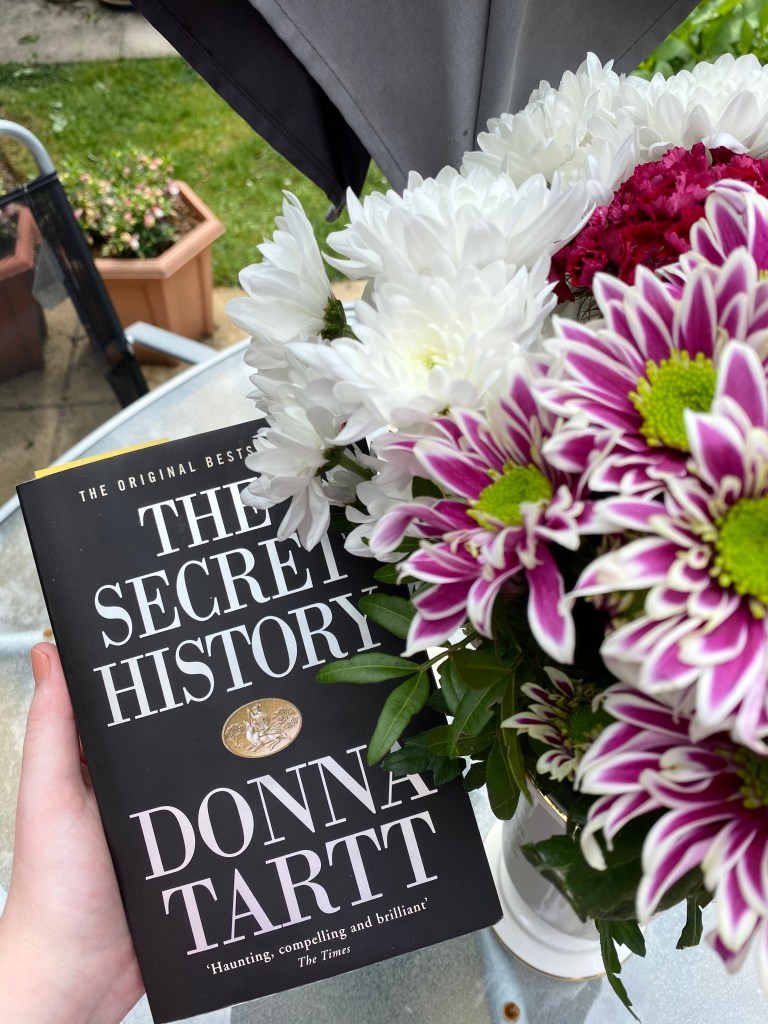
With The Secret History, not only is the plot an obvious discussion point but there are many underlying themes which are linked very well throughout. The book did take me a little while to get through, as the lengthy chapters would mean it would take me some time to get back into the plot when resuming reading. However, the thriller which progressed throughout kept me turning the page, becoming increasingly suspenseful with more and more plot progressions. Overall, I would 100% recommend this book to anyone looking for a new fiction book, especially one that does not fit neatly into one genre; it’s definitely not one to miss.
5/5 stars
 Soph's Library